
Send the Sun
Another Story From the Jukebox

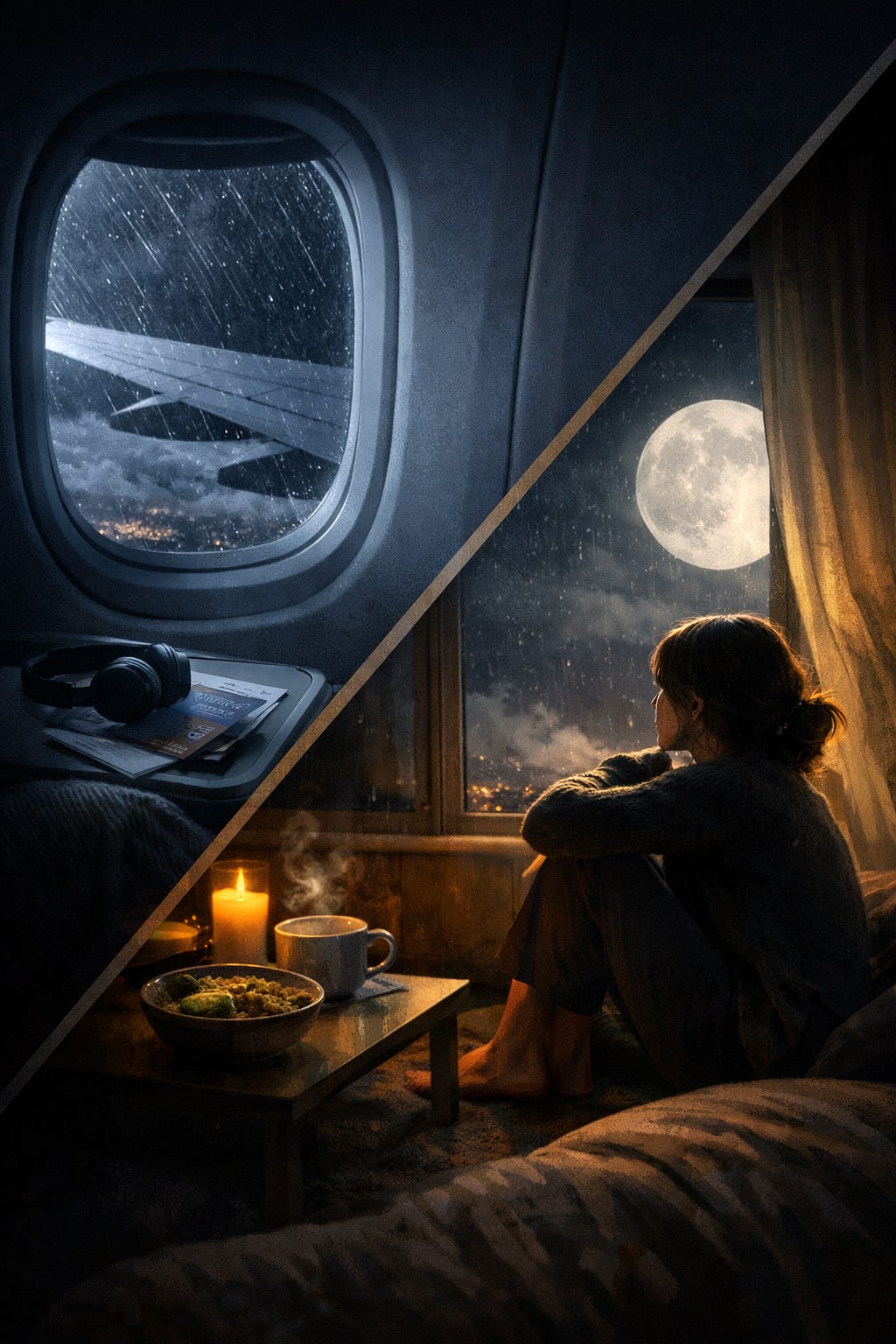
He left in Colder Weather, just after Christmas.
She doesn’t call. Not right away, anyway. The phone sits there on the kitchen counter like a relic from a different era—black, cordless, faintly buzzing with ghostly international static. Calling would be like shouting into a canyon just to hear your own echo warp back, distorted by time zones and whatever invisible perturbations are slinging him across the map this time. No, she thinks, better to let the orbit do its thing. Comets don’t appreciate being yanked mid-trajectory; they burn up or veer off into the void.
Instead, she brews tea. Earl Grey. That bergamot bite mimics the sharp edge of absence, without the melodrama. The steam curls up like question marks: Where now? How long? Who else? She sips it black, no sugar, because sweetness feels like cheating on the ritual. The moon’s still out there, judging, hanging low like a stage backlight. She stares at it through the window, thinking how it’s basically just a rock playing dress-up with borrowed sunlight. Kind of like her.
Has she trained herself to forget? Ha. As if. Forgetting would require a lobotomy or at least a decent amnesia plot from one of those noir novels she reads when the apartment gets too quiet. No, she carries him like a phantom limb: always there, itching in the periphery, making her reach for nothing in the middle of folding laundry or watering the ficus that’s somehow survived three years of her distracted care.
It’s not forgetting; it’s compartmentalizing with a side of quantum entanglement. He’s gone, but the wave function hasn’t collapsed yet. Schrödinger’s boyfriend: absent and present until the next perihelion.
Stoically passing the time? Sure, if stoic means curating a playlist of Tom Waits ballads mixed with ambient drone from some Icelandic composer she discovered on a late-night radio show. She reorganizes the bookshelf by emotional resonance rather than alphabet. She cooks elaborate meals and eats half, saves the rest as if he’s just popped out for cigarettes.
If she called and gushed—” Can’t wait, miss you like oxygen”—it’d spike the amplitude, risk interference patterns turning destructive. Better a dry-eyed equilibrium. She’s not waiting; she’s sustaining. Expanding into the vacuum with small, defiant acts of self-orbit: a bath with salts that smell like distant rain, a sketch of the moon in charcoal that smudges her fingers black as space
She’ll call eventually. Or more likely, text. When the tea’s gone cold and the moon’s traded shifts with the sun. Something measured, like “The ficus is plotting mutiny” or “Saw a comet in the news—reminded me.” Enough to sync the frequencies without syncing the lives. Because that’s the art of it: handling absence like a pro, with a poet’s eye and a comedian’s shrug.
She wouldn’t sing it. Not out loud, anyway—not the full thing, not with her voice cracking on the “darlin’” like she’s auditioning for a heartbreak tour. She’d hum the chorus under her breath maybe, once, while scrubbing the quinoa bowl that’s still sitting there like a tiny green accusation, the melody slipping out half-forgotten, half-defiant: I’m gonna send the sun your way... Then she’d stop, because finishing it feels like tempting fate, like invoking the dawn when the night’s still got hours to chew on her.
But listen? Yeah. She’d listen to Nikki Lane sing it—probably on repeat, low volume, the way you play something that’s both balm and bruise. Nikki has that road-worn twang, the kind that knows exactly how many miles “so many miles in between” really adds up to, how the West can feel like another planet when you’re staring at the same moon from a kitchen in sleet country.
The song’s got no illusions; it’s tender without being sticky, promises without pinky-swearing the impossible. I want you around / Don’t let the darkness get you down. It’s the exact opposite of clingy—it’s a love letter mailed with no return address, trusting the post office of celestial mechanics to deliver.
She’d put it on in the blue hour, when the apartment’s expanding again and the ficus is giving her side-eye for neglect. Maybe curled on the couch with the phone face-down. She’d let Nikki carry the weight of the words she won’t say herself: the “we got this love, let’s keep it right,” the quiet insistence that surviving the night is victory enough. No tears, no dramatic staring at the ceiling. Just a tiny, wry half-smile when the line about staring at the same moon hits, because yeah, lunar solidarity,
It’s not her anthem; it’s more like a field recording of her own frequency, caught on tape by someone else who gets the physics of long-haul longing. She’d listen because it says the thing cleanly, without her having to open the vault door.
And when it’s over, she’d hit play again, or maybe switch to Tom Waits growling something grittier, because balance is key in this resonance game. The darkness doesn’t get her down—not entirely—because she’s got Nikki on auxiliary, sending proxy sunlight across the time zones, hovering without collapsing into something ordinary.
She’ll take that over singing any day.

By the time we got to "Schrödinger’s boyfriend: absent and present until the next perihelion," I was hooked.