
Right Place, Wrong Time
Another Story From the Jukebox

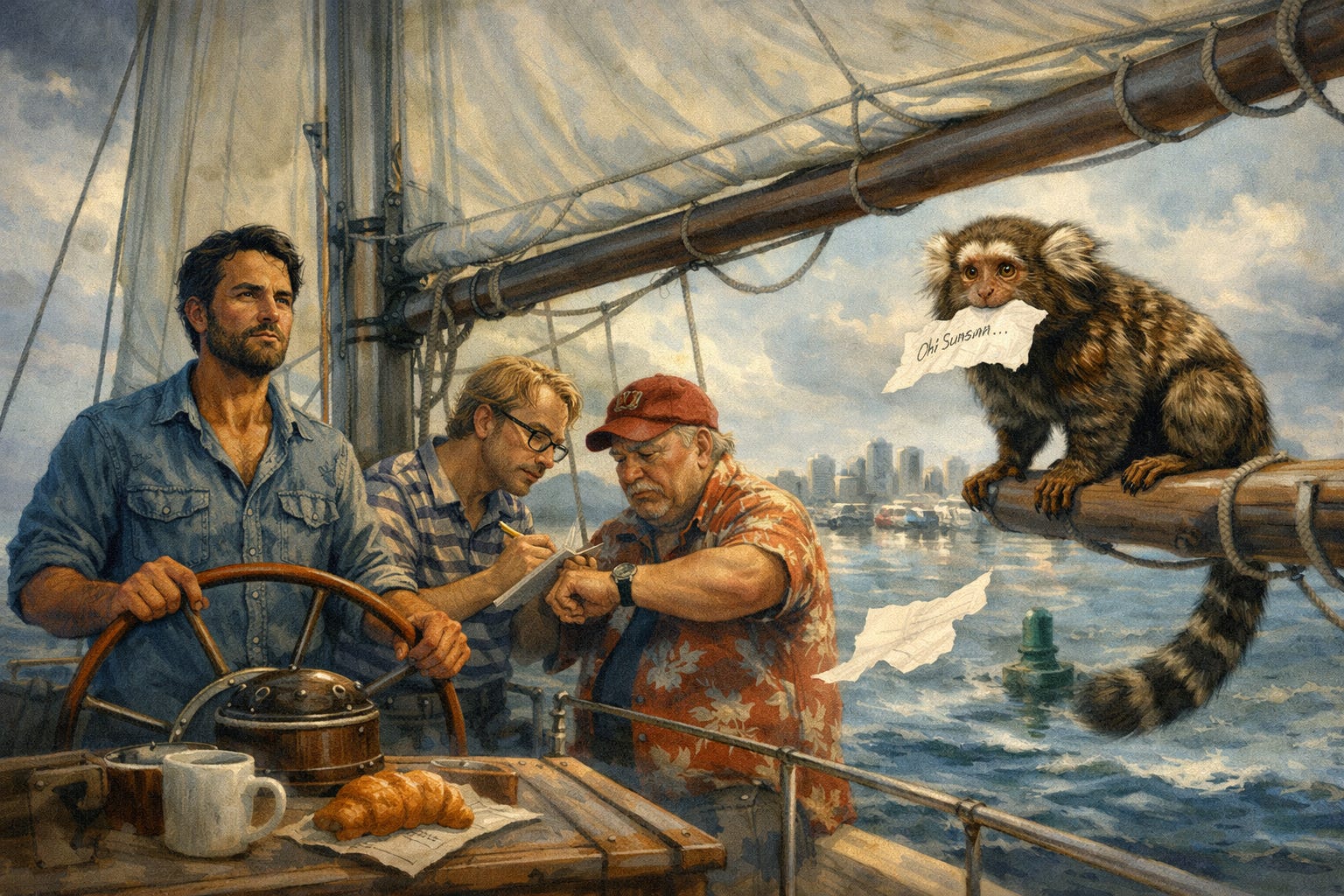
The sailboat was technically on course, satisfying the charts but no one aboard. Diego stood at the helm with the calm of a man who trusted wind more than intention, while Ludvig and Bubba argued softly about whether being early was a form of lateness in disguise. Alphonse, the marmoset, had already decided the day was misfiled. He sat on the boom with a strip of paper clenched in his teeth—Oh! Susanna, don’t you cry for me—chewing thoughtfully, as if lyrics were less a song than a receipt for time misspent.
The wind came from the southeast, faint with pastry, which Ludvig insisted was impossible and Bubba insisted was evidence. Diego said nothing. He eased the mainsail a hand’s width, and the boat responded the way a tired animal does—obedient, resentful. Alphonse dropped the lyric, watched it flutter, then leapt after it with a competence no one acknowledged. The paper did not hit the water. It simply failed to arrive.
By midmorning they were making time without making progress. The shoreline refused to commit. Bubba checked his watch twice, then turned it face down, as if time might behave better if ignored. Ludvig wrote a sonnet he would later deny writing. Diego whistled something tuneless, which may or may not have been the same song Alphonse was chewing.
Miles inland, a Range Rover merged onto Chartres Street, never doubting its purpose. Rachel rode in the passenger seat, legs crossed, watching Martha Stewart demonstrate the proper folding of dough on a screen too bright for the hour. Butter glistened. Order prevailed. Outside the window, the city drifted by in soft defiance. A cemetery rose briefly into view—white stone, iron gates, names stacked like closed ledgers—then slid away again, unimpressed.
At the same moment Diego adjusted course, the Range Rover changed lanes. Martha glitched almost imperceptibly. Alphonse paused, head cocked, eyes alert. He produced the lyric again—now creased differently, a verse missing—and tucked it into a place no one would think to check.
The day proceeded as if nothing unusual were happening, which was its most suspicious quality.
They passed the buoy twice before anyone acknowledged it. The first time, Ludvig marked it with a pencil stub. The second time Bubba laughed, a single bark, then stopped laughing when he saw the mark there. Diego squinted at the horizon, recalculated nothing, but adjusted everything. Alphonse clapped once—an unhelpful applause—then skittered below deck with purpose.
Below smelled of rope, citrus peel, and a French pastry someone had bought in a mood and forgotten in a bag. The croissant had collapsed into itself, dignified in its wretchedness. Alphonse took a bite, flakes falling like confetti, and sat back to consider the lyric again. It had changed. I come from Alabama with my banjo on my knee. He sniffed it, unimpressed, and hid it under the chart table where no one looked unless they were already lost.
In the Range Rover, Rachel adjusted the volume. Martha was explaining patience—how dough needed time, how rushing ruined texture. The woman driving nodded without looking, one hand on the wheel, the other drumming. They slowed near Jackson Square, tourists thickening the air. The cemetery appeared again, closer this time, mausoleums stacked like drawers. Rachel felt the tug, the sense of having missed an appointment she could not remember scheduling. On the screen, Martha smiled as if this were normal.
Back on the water, the sky tightened. Clouds rehearsed something dramatic and decided against it. Ludvig folded his sonnet, then unfolded it only to find a line he did not recall writing: Right place. Wrong time. Bubba asked Diego how long they’d been out. Diego answered honestly, which is to say not at all.
Alphonse reappeared on deck carrying the lyric like a white flag. He dropped it at Bubba’s feet, waited for the reaction, then snatched it back before meaning could settle. The boat lurched—not dangerously, just enough to suggest irritation.
They would later disagree about when they first noticed the music. Diego said it had always been there. Ludvig insisted it started inland. Bubba claimed it was the engine of the Range Rover, heard through water and time and stubbornness. Alphonse, licking sugar from his fingers, listened closely and began to hum.
The humming was wrong in the way clocks are wrong when they agree too closely. It threaded itself through the rigging and the argument and the pauses between words. Diego felt it first, not as sound but as pressure—like a hand resting briefly on his shoulder, then lifting. He looked at the compass. It pointed confidently at something he did not recognize.
Ludvig leaned over the rail and watched the wake fold back into itself. “We’re overlapping,” he said, meaning several things and none of them clearly. Bubba squinted at the horizon, where a line of cars shimmered improbably, heat-rippling along the water as if the road had misplaced itself. He did not mention this. He had learned, over years, that naming a thing too early encouraged it.
In the Range Rover, Rachel felt the hum settle into her chest like a second heart. Martha was now explaining preservation—how to store pastries so they retained their intention. Rachel glanced down at her phone, then out the window, then back again, the order of these actions suddenly important. The cemetery gate was open. It had not been before. She was sure of this in the way one is sure of dreams until breakfast intervenes.
The lyric surfaced again, exactly where it had no right to be: etched faintly into the condensation on the passenger-side window. Rachel traced a finger through the words without reading them, and they vanished, obedient as breath. The driver asked if she was cold. Rachel said no, she was early.
On the boat, Alphonse had gone still. This was new. He sat upright, tail wrapped neatly, eyes fixed on the shoreline-road-mirage. When he moved, it was decisive. He retrieved the lyric from beneath the chart table, tore it cleanly in half, and fed one piece to the sea. The other he tucked into his cheek, a private archive.
The boat shuddered, then steadied. The buoy did not appear a third time.
They made landfall without ceremony. No one cheered. No one apologized. Diego tied off the line with a knot he would later swear he learned as a child, though he had no memory of a childhood that included boats. Ludvig folded his sonnet. This time he did not unfold it. It rhymed with the sea. Bubba stretched, joints popping like punctuation.
Miles away, simultaneously, the Range Rover parked. Rachel stepped out into the heat, the hum fading as soon as her feet touched the ground. She stood at the edge of the cemetery and felt the relief of arrival without understanding the journey. In her pocket, she found crumbs of pastry and a scrap of paper she did not remember taking. Don’t you cry for me.
Alphonse, somewhere between the water and the street, stopped humming and went looking for something fresh to eat.
Writers of all stripes! Take the Jukebox challenge! Click below.

Maritime storytime, where the land and the sea meet, from the one and only, primalbeet.