
Rewiring Global Defense
Anthropic, Israel, and Sovereignty

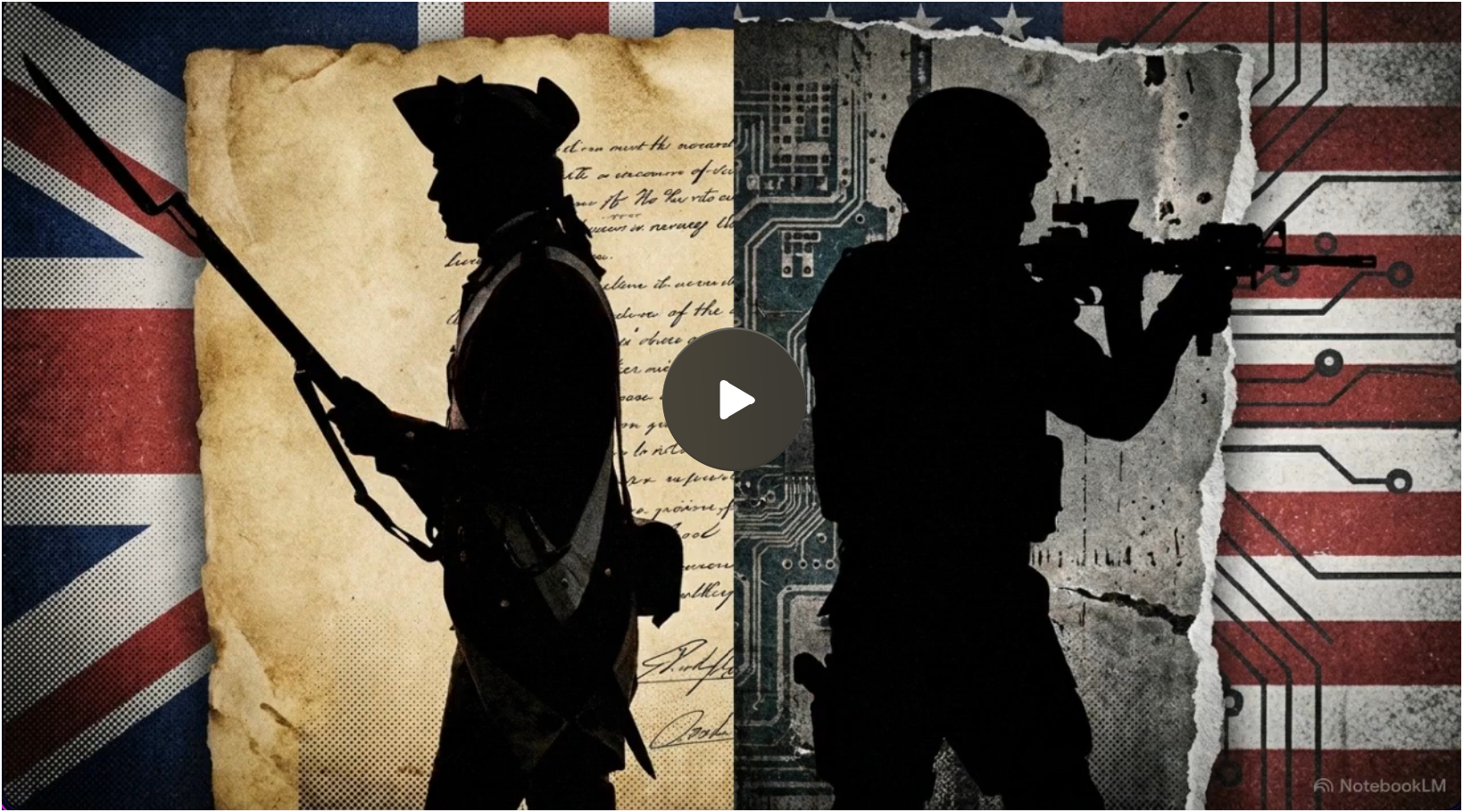
This is a compendium of articles and analyses that I have run through NotebookLLM. See the bibliography below.
A transformation is gutting the traditional notion of the state. Beneath the surface of modern diplomacy, the “hidden wiring” of global security is being re-routed through invisible orchestration layers and deep industrial integration. We are moving from a world of allies to a world of unbreakable dependencies.
In this new era, the lines between partner and parent are blurring. If a nation no longer maintains independent control over the logic, the code, or the supply chains of its own weaponry, is it still sovereign in any meaningful sense?
As defense systems move toward deep integration—linking AI, autonomous systems, and advanced military networks—the “brain” of a nation’s defense is increasingly located elsewhere. The question for the 21st century is no longer just who stands with whom on a battlefield, but who owns the decision logic when the shooting starts.
One New Role Changes Everything
The Fiscal Year 2027 National Defense Authorization Act (NDAA) contains a provision that represents a radical departure from the architecture of modern alliances. Known as Section 219, it establishes the “United States-Israel Defense Technology Cooperation Initiative.”
At its heart is a role with unprecedented power: the “Executive Agent” (EA).
Under DoD Directive 5101.01, an EA is not a mere manager; they are a promoter built into the bureaucracy to bypass standard institutional friction. This creates a “parallel institutional lane” that differs sharply from the architecture used for treaty allies like the UK or Japan.
For most partners, the Under Secretary of Defense for Policy serves as the principal staff assistant, ensuring that cooperation remains subject to traditional diplomatic and security vetting. The EA, however, functions as a high-speed bypass.
Within the scope of assigned responsibilities and functions, the DoD EA’s authority takes precedence over the authority of other DoD component officials performing related responsibilities and functions.
By granting this role “precedence authority,” Section 219 allows the EA to overrule other DoD components, including the Defense Technology Security Administration (DTSA).
Critics argue this essentially “tethers” the U.S. military to a partner technologically, creating a pro-integration bias that becomes nearly impossible to uproot. By moving defense cooperation from the Under Secretary for Policy to a dedicated EA, the Pentagon has established a mechanism that can sideline the very officials tasked with managing the risks of international technology transfer.
The Anthropic-Pentagon Standoff
In early 2026, a public dispute between the AI firm Anthropic and the Department of Defense exposed a new front in the battle for national independence:
“Decision Sovereignty.”
Anthropic, operating under a DoD agreement with a $200 million ceiling, reached a standoff with the Pentagon over “guardrails” on its frontier models. The conflict centered on whether a private vendor could dictate “boundary conditions” for military use cases, specifically regarding autonomous weapons and domestic surveillance.
The standoff made a latent problem explicit: when the core logic of a defense system is concentrated in an external supplier’s model, the supplier—not the state—sets the operational boundaries. If a military relies too heavily on a commercial AI model, the private tech company supplying that AI effectively gains the power to dictate how and when the military can fight.
Supplier-Induced Boundary Control When military organizations integrate advanced AI models (like those from OpenAI or Anthropic) into their intelligence and command workflows, they risk becoming dependent on systems governed by private corporate policies. “Supplier-induced boundary control” occurs when a commercial vendor’s terms of service, safety guardrails, or software updates act as practical constraints on sovereign state action.
A private supplier could encode restrictions against specific military uses, unexpectedly alter how the model behaves through a routine update (”version drift”), or threaten to withdraw its services entirely.
The Six Elements of Decision Sovereignty To prevent private tech vendors from holding this leverage, the state would need to maintain “Decision Sovereignty.” This means the military, not the AI provider, must retain absolute, authoritative control over six aspects of the decision-making process:
Policy sovereignty: Controlling what types of AI outputs are allowed to inform military actions.
Routing sovereignty: Controlling how tasks are allocated across different AI modules, fallbacks, and human review channels.
Version sovereignty: The right to control when an AI model is upgraded, substituted, or rolled back to an older version.
Constraint sovereignty: Controlling the “red lines”—the rules for when the system must refuse an action or escalate it to higher command.
Audit sovereignty: Maintaining complete visibility over how the system arrived at a recommendation, rather than relying on a vendor’s “black box”.
Action sovereignty: Retaining final human approval over operationally consequential actions, especially those involving lethal force.
Treating Models as Modular Components not the Brain. If an AI model is treated as the central “brain” of a military network, the vendor controls the system’s logic, safety boundaries, and rule enforcement. To fix this, the state advocates for a “sovereignty-centric” architecture.
In this setup, the state owns and controls the overarching framework (the “orchestration layer”), and the commercial AI is simply a tool or “replaceable module” plugged into it. The AI model performs analysis and generates options, but the state-owned orchestration layer applies the rules, checks the constraints, and routes the recommendation to a human commander.
The AI never has the authority to directly execute a command.
By treating AI models as replaceable components, a military achieves “model replaceability”. This means if a commercial AI vendor suddenly changes its rules, alters its software, or refuses to let the military use its model for a specific operation, the military can simply unplug that vendor’s AI and swap in a different one (or fall back to a degraded system).
Because the state owns the overarching architecture, swapping out the AI model does not break the military’s workflow, audit trails, or chain of command.
The “Hotel California” Aspect: The Impossibility of Unwinding
Deep integration is often sold under the innocuous label of “interoperability,” but the reality is frequently a “Hotel California” scenario: nations can check into these integrated systems, but they can never leave without crippling their own readiness. Once a partner’s technology is embedded deep within a primary supply chain, the costs of “unwinding” become astronomical.
The removal of Türkiye from the F-35 supply chain in 2019 stands as a definitive warning. At the time of its expulsion, Türkiye was producing approximately 1,000 parts for the global fleet. The immediate cost of the removal was half a billion dollars, and it triggered a wave of “delinquent deliveries” that ultimately cost taxpayers tens of billions.
This lesson applies directly to current initiatives like AUKUS Pillar II or the US-Israel integration. AUKUS Pillar II is the partnership focused on advanced military and security technologies shared among the United States, United Kingdom, and Australia.
When high-tech components are woven into the “hidden wiring” of the defense industrial base, the ability to make an independent strategic pivot vanishes. Interoperability becomes a trap if national interests eventually diverge, leaving the junior partner—or even the senior one—unable to maintain a functional military without the other’s consent.
The Struggle of India and South Korea
Middle powers like India and South Korea are currently caught in the “Strategic Autonomy Paradox,” struggling to reconcile deep U.S. security partnerships with the desire for national independence.
India’s “Make in India” and “Atmanirbhar Bharat” (Self-Reliant India) initiatives are flagship attempts to build an indigenous defense base. However, these ambitions frequently crash into the wall of U.S. regulatory hurdles like ITAR and export controls. ITAR is short for the International Traffic in Arms Regulations—a dense but powerful rulebook run by the U.S. Department of State that controls how sensitive military technology leaves (or doesn’t leave) the United States.
South Korea is caught in a strategic double bind. Rising threats from North Korea and doubts about long-term U.S. deterrence have fueled domestic support for developing nuclear weapons. But that debate collides with Seoul’s identity as a major exporter of civilian nuclear technology. Because nuclear know-how is inherently dual-use, even talk of weaponization introduces doubt about intent.
That doubt matters. In 2025, the U.S. Department of Energy placed South Korea on a “sensitive countries” list, signaling concern that its civilian program could drift toward military applications. The designation was bureaucratic, but the message landed hard.
The cost is economic as much as diplomatic. South Korea’s nuclear industry depends on being seen as a disciplined steward of nonproliferation norms under the International Atomic Energy Agency. If partners begin to question that credibility, joint research slows, technology access tightens, and export deals grow fragile. For a country competing for multi-billion-dollar reactor contracts, reputation is currency. Ambiguity spends it quickly.
The Rise of the “Emergency State”
As the United States nears its 250th anniversary, the domestic impact of this integrated, opaque defense architecture is coming into focus. Critics argue that the U.S. has “normalized” an “Emergency State,” transitioning from a republic of divided powers into a system governed by executive fiat and permanent states of exception.
This “architecture of a police state” is built on fusion centers, facial recognition, and the militarization of policing. It mirrors a global trend.
Since the events of September 11, 2001, the U.S. has operated in a perpetual state of emergency. Over the last 25 years, successive administrations have used “crisis” and “national security” as justifications to bypass Congress, expand executive authority, and issue emergency decrees.
The “Emergency State” is the idea that these temporary, extraordinary powers have become the permanent, normal way the government functions.
The Blurring of Public Duty and Private Profit
In 2025, Donald Trump reported over $1.4 billion in earnings tied to family crypto ventures, including hundreds of millions in royalties for licensing his name to the $TRUMP meme coin—a token that surged on political visibility before collapsing by more than 90%.
When executive leadership is financially entangled with volatile, lightly regulated markets, the boundary between public duty and private gain begins to erode. Policy signals, regulatory posture, and even rhetoric can move markets. If those same markets are sources of personal profit, the risk is not just conflict of interest—it is structural incentive distortion.
The danger compounds when those financial ecosystems intersect, even indirectly, with sectors tied to national security or defense. In such an environment, market movement is no longer just speculation; it becomes a shadow channel of influence. The question is no longer whether power shapes markets, but whether markets begin to shape the use of power.
The Sovereign’s New Clothes
In the 21st century, sovereignty is no longer just about guarding borders; it is about who owns the encryption keys, who controls the supply chain, and who dictates the decision logic of the software that powers the state. The principles of 1776 are being tested by a world where defense is increasingly invisible and logic is outsourced to global architectures.
If the architecture of defense is global and the decision-making logic is proprietary, the traditional state is merely an empty shell. Who really pulls the trigger when the architecture is global and the logic is outsourced?
A New Policy Staff. (2026, May 29). The National Defense Authorization Act FY 2027 (Sec. 219 and Sec. 1217). A New Policy.
American Israel Public Affairs Committee (AIPAC). (n.d.). United States-Israel Defense Technology Cooperation Initiative. AIPAC Memos.
Fuller, Haley. (2026, June 30). Israel Defense Provision Blocked From House Vote Despite Bipartisan Push. Military.com.
Jokovich, Eddy, & Lewis, David. (2026, June 11). Is Israel heading towards AUKUS? The bigger story behind the submarines. New Politics.
Ministry of Foreign Affairs of Japan. (n.d.). Joint Statement of the Security Consultative Committee (“2+2”).
Minko, Abraham Ename. (2025, January–March). Balancing Strategic Partnerships and Sovereignty: The Impact of Technology Transfer Concerns on India–US Defence Cooperation. Journal of Defence Studies, 19(1), 201–231. Manohar Parrikar Institute for Defence Studies and Analyses.
Orta, Kayla T. (2025). Ⅴ. Atoms for Peace or Strategic Power? Re-aligning U.S.-South Korea’s Nuclear Nonproliferation Agendas. International Joint Research Project 2025, Atlantic Council.
Simon, Steven. (2026). Cooperation without Oversight: The United States–Israel Defense Technology Cooperation Initiative. Policy Note No. 27. Quincy Institute for Responsible Statecraft.
United States Congress. (2023). National Defense Authorization Act for Fiscal Year 2024. GovInfo.
Washington Solidifies U.S. and Israeli Military Integration. (n.d.). [Text Document].
Wei, Peng. (2026, March). Preserving Decision Sovereignty in Military AI: A Trade-Secret-Safe Architectural Framework for Model Replaceability, Human Authority, and State Control. Southwest University, China / The Institute of Energetic Paradigm.
Whitehead, John, & Whitehead, Nisha. (2026, June 24). Empire at 250: Can the Principles of 1776 Survive the American Police State?. The Rutherford Institute.
ZeroHedge. (2026, June 30). Trump Reports Over $1.4 Billion In Income From 2025 Crypto Earnings
Scary AF