
A Bar In Amsterdam
Another Story From the Jukebox

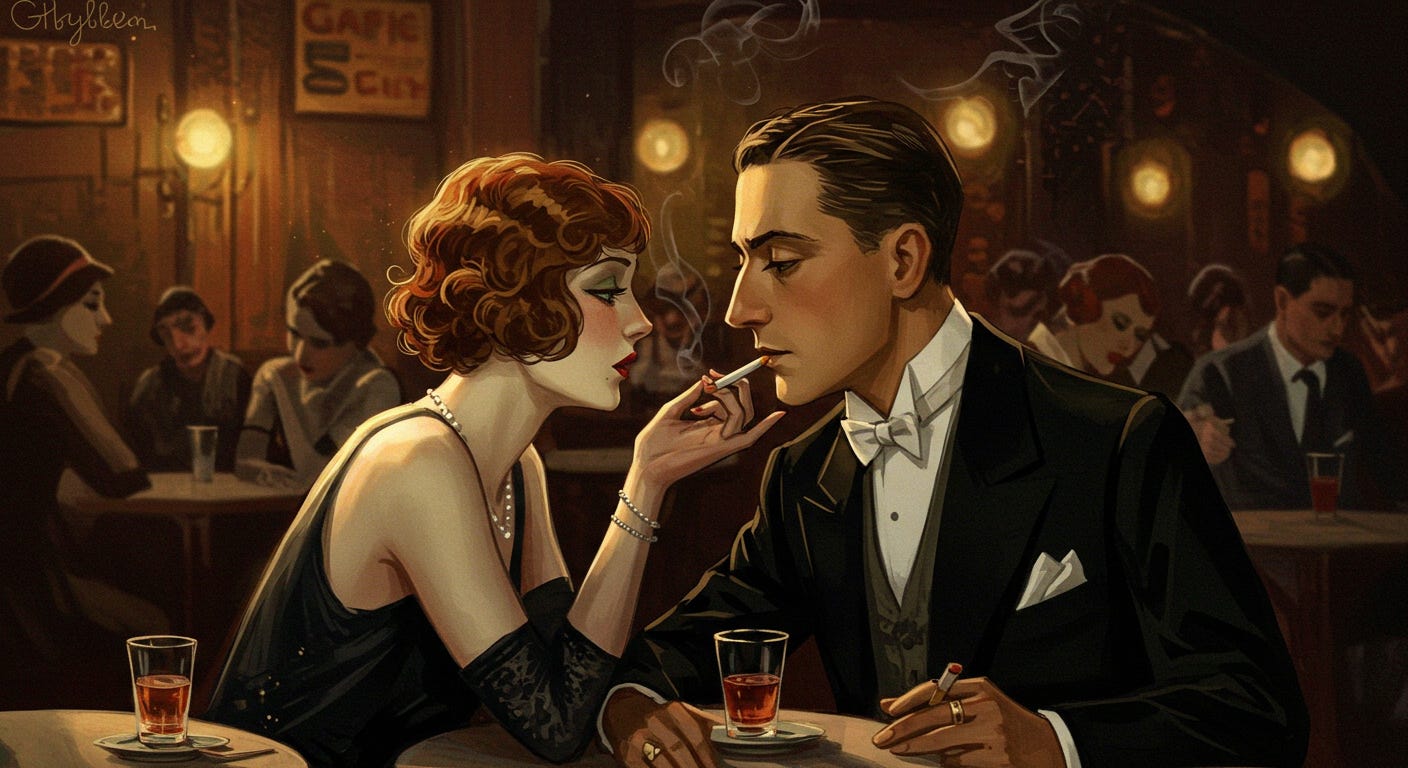
Café Größenwahn
Berlin, 1927

Espresso, bold as redemption,
Cuts the fog behind your eyes,
wakes the ghosts that hadn’t planned to rise.

Smoke climbs slow.
Wanders.
Figures dissolve in the gaslight
like half-remembered songs.

She laughs—
a woman in sequins,
sprawled over the armrest
like gravity’s for other people.
One silk leg dangling
like punctuation on a story
no one bothers telling.

The man at the next table—
quick wrist, raw nerves—
scratching faces onto a napkin.
Marlene? Anita?
Or just another girl wearing
fleeting fame like a borrowed coat.

His coffee’s cold.
He drinks it anyway.
Habit. Or penance.
Or both.

Clarinet slides in,
late, lazy,
like it’s finding its footing in the dark.
Trumpet follows, sharp, sly,
piano’s all elbow and memory,
keys hit like a tired debate.
Street tilts and sways.

Someone orders absinthe.
Another spills vermouth
on a dangerous screed.
The air’s a cocktail:
ink, perfume, sweat, static.
Even the walls are listening.

Inflation!
Indecency!
A new world.
Headlines dance, but we dance faster.

Future flickers
at the seam of things,
a war-torn edge,
stitched with smoke and possibility.

He leans in.
Eyes lit like a fuse.
He’s selling something:
a fix,
a faith,
a kiss sharp enough to scar.

You don’t say yes, or no.
You just inhale
and let the music decide.Café Größenwahn
Berlin, 1927
The espresso was black enough to confess to. It arrived with no ceremony, just the sharp clap of porcelain on wood, and steam that curled up like something trying to escape. She sipped it, and the fog behind her eyes scattered like startled pigeons. Ghosts stirred. Ghosts always stirred in Café Größenwahn.
Smoke climbed in spirals above the tables, hesitant, sensual. It hung in the gaslight like old lace, veiling the room just enough to make everyone a little more beautiful, a little less accountable.
The woman in sequins laughed—a loose, rich sound that didn’t ask permission. She was draped over the armrest of a red velvet chair as if gravity were a rumor she’d outgrown. One silk-stockinged leg dangled carelessly, a bold question mark at the end of a sentence nobody had the nerve to parse.
At the next table, a man with a jittery wrist sketched faces onto a napkin. His fingers were stained with ink and tremor. The women in his drawing looked like echoes—one might have been Marlene, another had Anita’s cheekbones, or maybe it was just another fleeting starlet wearing fame like a borrowed coat, two sizes too large.
His coffee had gone cold. He drank it anyway, eyes never leaving the paper. Habit, maybe. Penance, more likely.
Then the clarinet arrived—late, languid, like someone finding their way home through a fog. A trumpet teased in next, sly and sharp. The piano didn’t play so much as argue, each note elbowing the last, each chord like a tired memory insisting on its version of the truth.
Outside, the street tilted. Inside, it swayed.
Someone shouted for absinthe, as if it were a person. A glass of vermouth toppled over a newspaper scrawled with manifesto and menace. The floor grew sticky with ideas.
The air itself was a strange cocktail: ink, perfume, sweat, and static. Everything had a scent. Even the wallpaper seemed to be eavesdropping.
Headlines screamed from the cafe walls—Inflation! Indecency! A New Order! But nobody was reading. They were dancing. Faster than the news, deeper than the fear.
The future lived here too. You could see it if you looked close—flickering in the corners, stitched into cigarette smoke and saxophone notes. A glint at the hem of the moment. A warning. A promise.
He leaned toward her—this man she hadn’t noticed until now, though he seemed too perfectly placed to be chance. His features were elegant in a forgettable way, like the face of an ideal you didn’t know you believed in.
His eyes were lit with promise, the kind that razes cities in the name of order.
He didn’t speak right away. Just let silence gather between them like velvet.
Then, gently: “You need not be uncertain.”
His voice was clean, warm, reasonable. It offered safety the way a cage might offer peace. Destiny. The quiet kind that smiles as it closes the door. He studied her like an architect placing a gargoyle.
She watched him, some part of her already leaning in.
Not because she believed him. Because she wanted to.
She didn’t answer.
She just inhaled.
And let the music decide.

“The floor grew sticky with ideas.” - great line to accentuate the visuals!
Magnificent, Rick! Please don't forget to add it to the comments of the newsletter.